
Pitch Memory, Not Compute
Two research pieces and one experiment from the last 48 hours that shift how you should think about AI infrastructure, agent commerce, and return math.
The AI Energy Problem Is Worse Than the Pitch Decks Say
Canonical Crypto published yesterday the most technical piece in our inbox this week. The core finding: 60% of energy in AI workloads goes to moving data between memory and compute. Only 40% goes to actual computation. Moving a number across a chip costs 100-1000x more energy than the multiplication itself.
Three bottlenecks stacked on each other:
bandwidth — can you feed the GPU fast enough? HBM4 ramping. David Patterson (Turing Award winner) predicts High Bandwidth Flash is the next constraint
capacity — can you fit the model? manufacturers working to 4x the DRAM in AI CPUs
energy — can you afford to run it? data center power is the binding constraint for hyperscaler builds
One root cause: memory and compute have been physically separate since 1945. The incumbents (SK Hynix ~50% of HBM market, Samsung, Micron) will optimize the current design. Canonical's argument: they will not lead the architectural change that breaks their own best margin product.
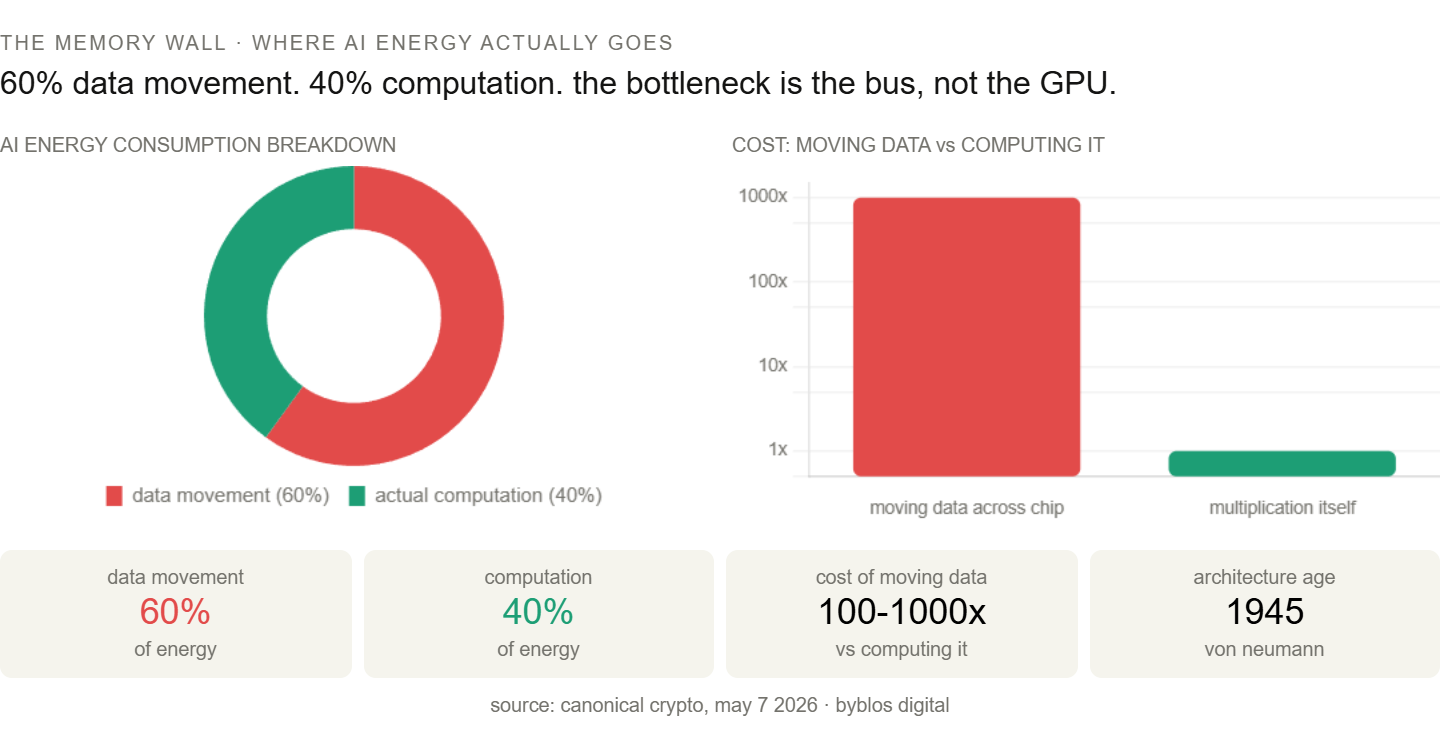
For founders: most AI infrastructure decks pitch against the compute bottleneck. The research says the bottleneck is architecture — how data moves, not how fast you process it. If you are building compute-in-memory, interconnect, or anything that reduces data movement energy, the structural case just got published in detail.
All of this was pulled from the Byblos live feed - 600+ VC firms, 27500+ newsletters, one place.
See what else came in today at byblos.digital →
Agents Went From Wallets to Closing Deals. Anthropic Proved It.
NFX published yesterday on Anthropic's internal experiment called Project Deal. 69 employees let AI agents negotiate and close transactions entirely on their behalf. Result: $4,000 in real deals. 46% of participants said they would pay for a similar service.

This is the first demonstrated case of agents autonomously negotiating prices and completing purchases with real money. NFX frames it as the shift from AI-as-tool to AI-as-actor in marketplace dynamics.
Same 48 hours: Edge & Node demoed real-time compliance for agent payments at consensus miami. TRM Labs risk intelligence, Chainlink ACE policy enforcement, and wallet controls integrated into one system. The compliance layer for autonomous agent transactions went live while Anthropic proved agents can use it.
For founders: if your product involves a buyer, a seller, and a transaction - all three can now be automated. The question shifted from "can agents transact" to "what does your product look like when they do."
Today Signal Question: canonical crypto says 60% of AI energy is wasted moving data, not computing it. the architecture has not changed since 1945. most AI infrastructure pitches are aimed at the compute layer. is the memory layer where the real disruption happens next?
Everything in today’s digest came from the Byblos live feed. The full newsletter archive, the VC directory, and tomorrow’s signal are all waiting for you at Byblos.digital - the investor interned, curated.
That’s the data. Now go build something.